English version Martha Pskowski
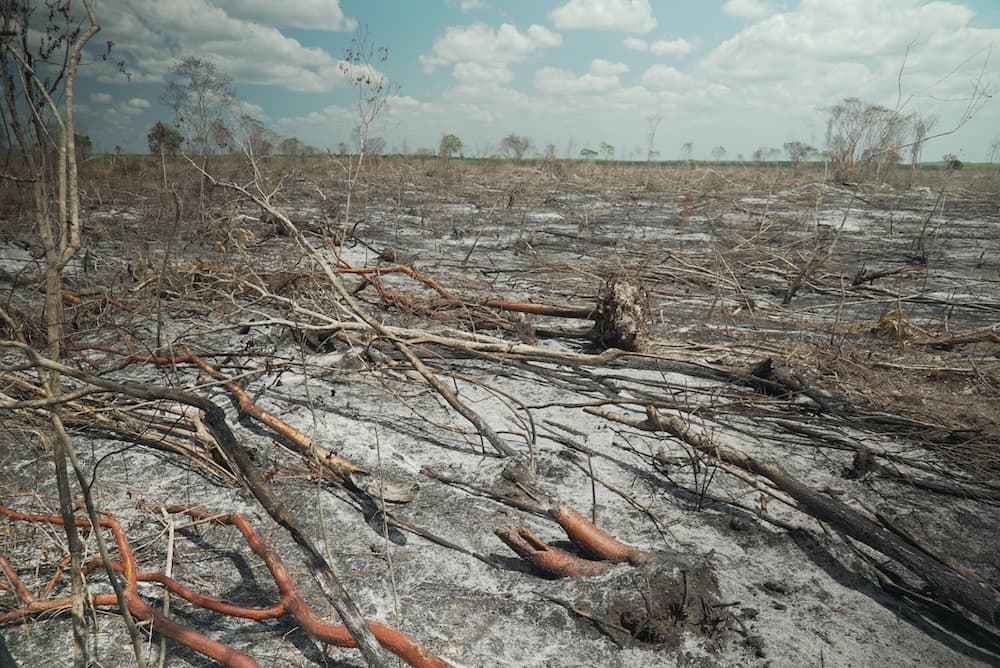
In late April 2025, the National Environment Prosecutor’s Office (Profepa) closed one quarter of the oil palm processing plants in Mexico for violating environmental laws. For decades, journalists and academics have warned that palm oil production causes water, soil and air pollution, in addition to fomenting deforestation and harming biodiversity.
But less well-known is who reaps the economic benefits of this devastation.
A week after the plants were shuttered, representatives of 11 companies, which together own about 55 percent of the processing plants in the country, acknowledged what the National Human Rights Commission (Comisión Nacional de los Derechos Humanos, CNDH) has documented since 2019: that there were African palm (Elaeis guineensis) plantations within the La Encrucijada (Rebien) Biosphere Reserve, a national protected area. The companies promised, just as they had in 2022, to address the problem.
Rebien is not the only case. Using satellite technology, an interdisciplinary group of researchers proved that between 2014 and 2022, more than 7,500 hectares of conservation zones had been turned into oil palm plantations1. This doesn’t include the African palm plants that have spread on their own without being cultivated. The environmental problem extends to the conservation zones bordering oil palm cultivation. Mangroves, rainforests and dunes among the water-rich and biodiverse ecosystems that have been impacted.
Between 2018 and 2024, 76 manatees died in Tabasco. The first suspected culprit was the national oil company Pemex. But the final report indicated that excess nutrients in the water, in addition to high concentrations of heavy metals, killed the manatees. The nutrients came from pesticides, agricultural fertilizers, and the “oil palm plantations that contribute to eutrophication and the proliferation of cyanobacteria,” according to the report.
High Consumption and Low Production
Mexico has the third highest consumption of palm oil in Latin America, trailing only Colombia and Brazil. But to satisfy its enormous ultraprocessed food industry, which requires palm oil for practically every recipe, Mexico imports more palm oil than any other Latin American country.
Mexico is a distant sixth place in palm oil production in the region. This makes Mexican companies dependent on imports, especially from Guatemala, Costa Rica, Honduras and Colombia. The Mexican government has tried to reverse this trend and accomplish two goals: to guarantee self-sufficiency through domestic agroindustry and to reduce production costs for the industry.
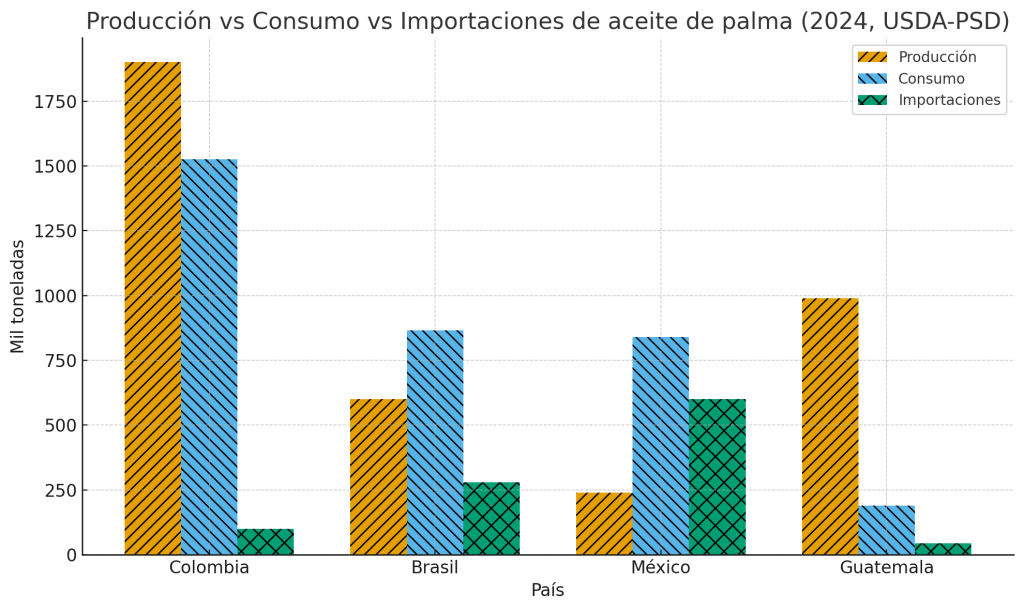
This means rural areas are paying the price while the business class in urban areas reaps the profits.
The economy ministry’s data confirms this trend. In 2024, Mexico City represented 42.6 percent of palm oil imports, followed by Jalisco at 39.5 percent and the State of Mexico at 15.9 percent. Meanwhile Veracruz, Chiapas, Campeche and Tabasco are the only palm oil producing states. The poverty rates in these states oscillate between 45 and 67 percent, while the major importing companies are headquartered in four states that are among Mexico’s wealthiest.
According to the Honduran palm oil giant GK Global, 50 percent of manufactured products in supermarkets include this key ingredient. Mexico has the potential to compete directly with Colombia for the surface area planted in palm, according to the National Agriculture Plan 2017-30. An expansion of this scale would be disastrous for the environment.
Processing plants, which extract oil from the palm, are key nodes in the industrial process. They are generally built near the plantations to ensure the palm is processed before the highly oily contents go bad and start rotting. No matter how much palm is grown, without these plants the business would grind to a halt.
No matter how much palm is grown, without these plants the business would grind to a halt.
In order to understand which companies benefit from oil palm cultivation in Mexico, we mapped the processing plants nationwide. We found 20 active plants and one that had been dismantled, presumably after a bankruptcy. While the 2024 Femexpalma report said that there are three more under construction, we could not find their locations or owners.
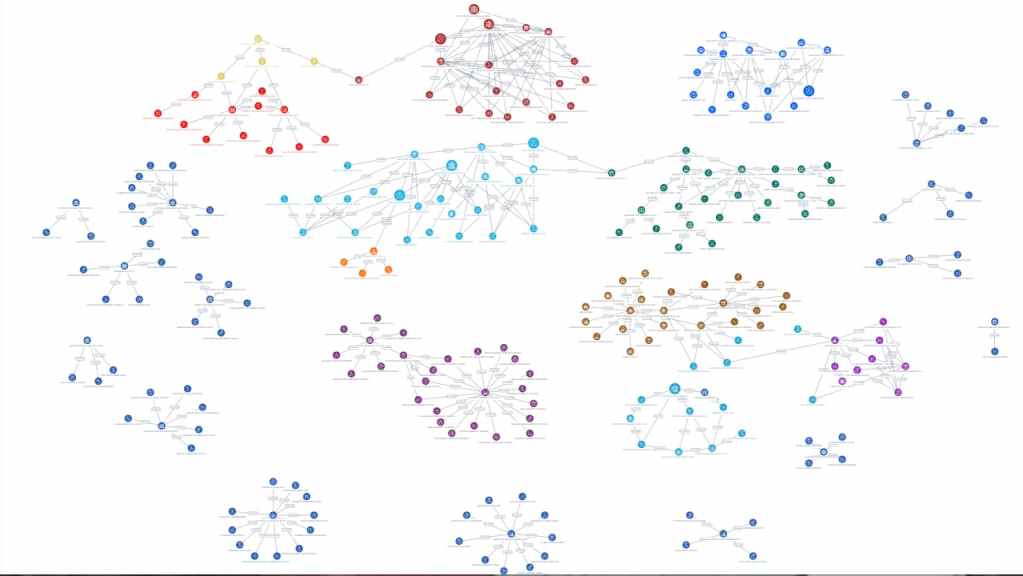
Next we cross referenced purchasing data that companies report to the Roundtable on Sustainable Palm Oil (RSPO). This organization was founded by the industry under the auspices of improving supply chain transparency and facilitating “traceability” of oil palm globally. This generated a list of 25 companies that had purchased palm oil from Mexican processing plants at least once in the last five years.
This list is a first step but is far from exhaustive. It leaves out companies that use oil palm but are not members of RSPO, in other words that aren’t interested in the greenwashing the organization provides. One example is the snack food company Totis, now owned by La Costeña, which uses oil palm but does not show up in the RSPO list.
The Beginning, in Times of War
In the documentary Fog of War, Robert Strange McNamara says that if the United States had lost World War II, he would have been tried for war crimes. No one, at least those who know their history, would disagree. Despite this, or maybe because of it, John F. Kennedy named McNamara as Secretary of Defense during the Vietnam War. He stayed in the post until he stated that it was an impossible war to win. At that point President Johnson, who succeeded Kennedy after his assasination, “abruptly” named him to be the fifth president of the World Bank.
It was 1968, a leap year that started on a Monday, which the United Nations declared to be the International Year of Human Rights. It was the year of the Prague Spring, May 68 in France, the assasination of Kennedy and the student massacre in Mexico City’s Tlatelolco, before the Olympic Games in that country. From his new outpost in the international bank, McNamara fought the Cold War with million dollar loans. His logic was to distance the “underdeveloped world” (Global South) from Soviet communism, all while integrating China to the global banking system.

In 1973, in Nairobi, McNamara launched his “war on poverty” in rural areas, coinciding with the poorly-named Green Revolution. The Green Revolution, which started with experiments in Mexico, was a series of strategies that included mechanizing and industrializing agriculture, introducing seeds “improved” by genetic modification, and intensive use of agrochemicals, many of them toxic, for monocrop agriculture. The stated objective was ending global hunger, but in reality the program served to stabilize prices of raw agricultural materials, including oil palm.
The arrival of this monocrop to Latin America, “was a creation of the gringos because they were losing southeast Asia and were at risk of losing access to oil for their planes,” and the war economy in general, according to León Enrique Ávila, researcher at the International University of Chiapas.
During World War II, the British Empire had used oil palm to make a variety of products: soap, margarine, candles, lubricants and, perhaps most importantly, explosives such as nitroglycerin. Meanwhile the United States used palm oil for the synthetic fabrication of palmitic acid, a key ingredient for napalm, which the U.S. Army, under McNamara’s orders, used to burn thousands of people and devastate enormous areas of rainforest and farms during the Korean and Vietnam wars.
According to declassified World Bank documents, between 1965 and 1975, the bank participated in 22 oil palm projects in nine Asian, African and Latin American countries, with a total investment of $272 million. And — surprise, surprise — during this same period global trade in palm oil doubled. It shifted from a “hard” oil used in industrial processes, known for the difficulty extracting and refining it compared to other oils, to being used as a substitute for different vegetable oils in the food industry, such as soy oil2.
If sugar cane, with its slave plantations, was “capitalism’s favorite child” in the colonial and postcolonial period, oil palm became the favorite child of industrial capitalism.
Rural people, working in precarious states of dependency, were sold the promise of getting ahead and escaping poverty. But ultimately, rural communities pay the social and environmental costs while the industrial class claims the profits.
The Humid Tropics Agricultural Development Project (PRODERITH I) began in 1972 in Mexico. But it wasn’t until 1978 that the World Bank approved the 1553-ME loan for $56 million to build an experimental 1,000 to 2,000 hectare oil palm plantation and pilot project alongside a processing plant.
The Neoliberal Trick
When Jerónimo moved to the Valley of Tulijá in 1995, oil palm was not yet a problem in Chiapas. There were few hectares in cultivation and there was plenty of water to go around. Preparing the flood-prone land where Jerónimo lived to plant crops and raise livestock required patience and hard work. Thirty years later, the oil palm has surrounded him. The government’s promise that they would “get rich” by planting an “easy” and “profitable” crop attracted thousands of peasant farmer families and ranchers. Others simply had no alternative.
Many families ended up in the area now dominated by oil palms because of the armed uprising of the first organized anti-neoliberal movement in history: the Zapatista Army of National Liberation (EZLN). The Indigenous guerrilla movement opposed inequality, racism and the structural oppression in Mexico, rising up on the same day that the North American Free Trade Agreement (NAFTA) went into effect between the United States, Mexico and Canada.
The movement set off a wave of repercussions for the land tenure of diverse Indigenous communities, trade organizations and peasant farmers who had for years organized against the land holding class and paramilitary violence in Chiapas. The administration of then president Ernesto Zedillo, who consolidated the neoliberal project in Mexico, convinced large landholders to sell land, which rural people could the purchase with 30-year no interest credits, in an effort to diminish, even if temporarily, the tensions raised by the EZLN’s armed struggle in a historically impoverished, racialized and oppressed population3.

In addition, trusts were created to distribute funding and financing for economic projects that, at the same time, would serve to dismantle the social movements and Zapatista support groups. This wave of investment for “development” in rural communities led people to acquire land in the hope of forming ejidos, a legal structure for communal lands in Mexico, to resolve their historic demands.
“These lands were given to us as part of a trust. It’s not a lot, it’s a small area, only about 3.6 hectares for each farmer,” recalls Nicolás Arcos, a member of the Central Unitaria de Trabajadores. But they had been tricked. They had been given lowlands that were prone to flooding.
“You couldn’t grow beans, you couldn’t grow maize, nothing else either. Because the seeds would rot. So then the leader tells us they’re going to bring a project.” That project was African palm.
The government gave them the seeds and promised them that three years later a company would buy what they produced. But those companies —and their promises— were slow to arrive.
The Business Response
As its founders have repeated on multiple occasions, “The Chiapas Fund is the business community’s response to the Zapatista uprising.” In 1993, the company was founded under the name Jalisco Fund, in Guadalajara, one of the three most important cities in Mexico. The fund was located in the west-central state of Jalisco, known for being an agricultural and industrial powerhouse. Jalisco is also marked by its religious conservatism, classism, racism and the presence of far-right groups.
At 10 a.m. on October 9, 1995, the “Jalisco Investment Fund” changed its name to the “Chiapas Fund S.A. de C.V. Sociedad de Inversión de Capitales” and moved its headquarters to Tuxtla Gutiérrez, the capital of Chiapas. It changed hands from a small group of local businesspeople to the state of Chiapas, which owned a 39.91 percent stake, the National Finance bank, which owned 9.09 percent, and several other members of the Mexican oligarchy, who each owned 8.5 percent.
According to its general director, Gustavo González Padilla, the Chiapas Fund was a project of Eduardo Robledo Rincón. At the time Robledo Rincón was running for governor of Chiapas for the PRI party, the hegemonic party that governed Mexico for 71 years. The political and business class was closing ranks against the revindication of rights demanded by the Zapatista Army. Under the guise of preventing a new wave of revolutionaries that could overtake the poorest states in the country, they found a new way to earn profits at the expense of the poor.

photo: Matthew T Rader
Like any good PRI candidate of the era, Robledo Rincón’s victory was a foregone conclusion and he began preparing his administration before winning the election. Like other hand-picked PRI candidates, he won the election. But the EZLN, accusing him of electoral fraud, demanded he resign as a condition to start peace negotiations. Robledo was sent to Argentina as ambassador and in 1999 was named to lead the Ministry of Agrarian Reform.
The Chiapas Fund was made up of business leaders and economic groups from around the country. One of them was one of the companies most favored by neoliberal governments, Jorge Ballesteros’ Mexican Development Group (GMD), which was saved from bankruptcy during the Zedillo-era bailouts. The company’s administrative council included Valentín Díez Morodo of the powerful beer conglomerate Grupo Modelo and owner of the Promotora e Inmobiliaria Cuyd, an investor in the Chiapas Fund.
Among the financiers were Banca Serfin (now Santander), represented at the time by Adrián Sada, Bancrecer (now Banorte), owned at that time by Roberto Alcántara Rojas, who later led the company to bankruptcy in 1999, which cost the Mexican government millions. The Grupo Financiero Banorte, owned by Carlos Hank González, joined more recently. Hank González descends from one of the most powerful political and economic dynasties in Mexico. His father Carlos Hank Rhon was also a board member of GMD.
Enrique Molina Sobrino led the Chiapas Fund and was one of its most visible faces. He started the Mexican Bottling Group (Gemex), later PepsiCo de México, which Molina sold in 2002. Like the previously mentioned bankers, Molina was a beneficiary of the wave of privatization under president Carlos Salinas de Gortari (1988-1994). This allowed him to start the Consorcio Azucarero Escorpión (Caze), one of the most important companies in the sugar industry, which has been linked to several corruption scandals.
Another key figure in the fund was Alfonso Romo Garza, through Grupo Pulsar. After Romo sold his cigar company to British American Tobacco, he was considered one of the richest men in Mexico, between 1998 and 2000, before he had turned 50. He then went all in on Seminis, a company that eventually would control 22 percent of the international market for genetically modified seeds.
Nonetheless, the genetically modified food business did not deliver what he expected and he sold Seminis to Monsanto (now Bayer). His agro-bioengineering company Agromod is still an important player, especially for papaya, agave and coffee. In 2011, Agromod developed the robusta coffee plants for the Nescafé plan in Mexico. One of the intermediaries in this plan is Agroindustrial Unidas de México, parent company of the oil palm processing plant Agroforestal Uumbal.
Networks of Palm Businesses
“I give away firewood to old people. But those who plant palm, I won’t even sell to them,” Jerónimo said while eating a breakfast of eggs laid by his hens. With the eggs, he eats tortillas his wife just made from corn that they grow together.
The papaya and bananas also grew on their land, which forms an oasis in the middle of a green desert of monoculture palm plantations. With the income from selling medicinal plants and fruit that grow on their property, they buy coffee and flour to bake homemade bread.
Their neighbors, who deforested to plant palm, now don’t have anywhere to collect firewood for cooking. In these rainforest communities, there are no public services. No gas, no electricity, no running water nor sewer lines. Much of what they eat is packaged food from the store, because that’s what is for sale: sodas and ultraprocessed foods.“I documented that there was a lot of hunger in the Tuiljá region when the price of palm went down. People don’t talk about it, but they went hungry then,” said León Ávila, professor at the Intercultural University of Chiapas.
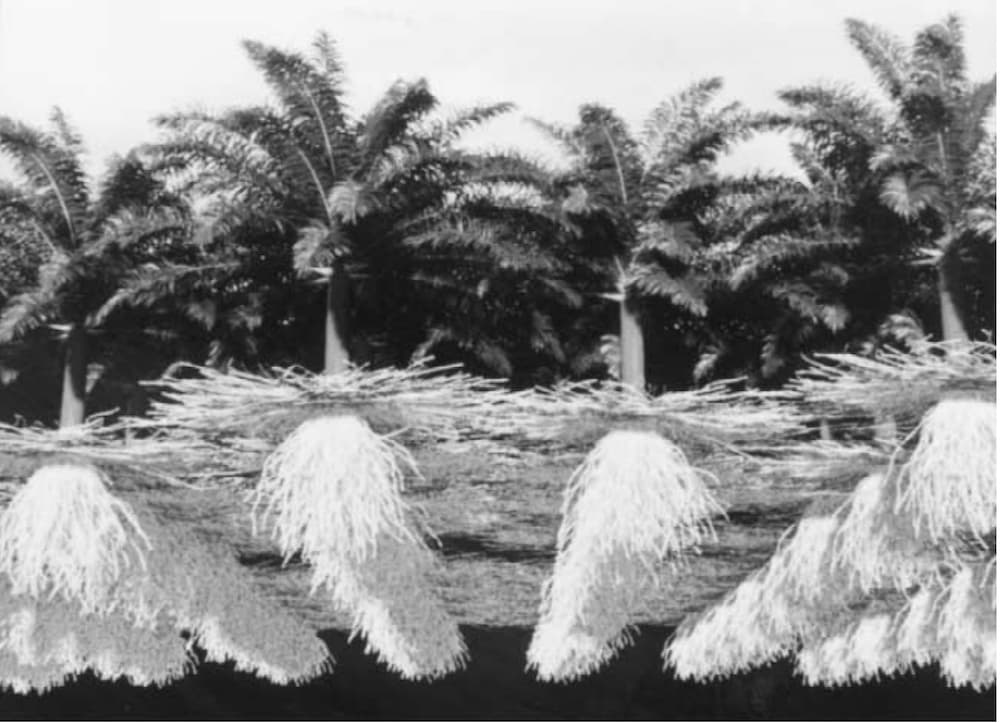
The roots of the palm oil tree grow out to the side and deep down, absorbing all the available water and creating a web that prevents any other plants from growing. Jerónimo and his family survive thanks to their proximity to the river. But in other communities the situation is critical, not only in terms of water scarcity but other forms of violence. For example, to get water to cook or wash with, women now have to walk several kilometers to the river. Along the way, they have to go around plantations that they are not allowed to cross. In other cases, they are sexually harassed by the security guards and skilled workers.
Once you are surrounded by the palm plants, the chatter of the rainforest disappears.
“Where there are palms, the animals don’t go there. No, not there. There’s silence,” Jerónimo said while pointing at a red ant where a few tree roots had been cut with a machete. “This is the tree that sings. They’re killing it to plant palm. They make marimbas out of these trees,” he said, referring to the traditional musical instrument of the four states where palm is cultivated: Chiapas, Campeche, Tabasco and Veracruz. The impacts aren’t only environmental and social, they are also cultural.
The Good Life, the Good Palm
Elaeis guineensis comes from West Africa, giving it the name African palm. However, the palm industry tries to avoid this nomenclature to downplay the invasive nature of the plant. In Mexico, there is archival evidence that oil palm was planted on the coast of Jalisco in the early 1940s. But the academic consensus is that the first plantation of Elaeis guineensis began in 1948 in Veracruz, on the property of then president Miguel Alemán.
Evidence indicates that the United Fruit Company4 brought the first plants to Mexico from Costa Rica. The well-known banana company has for decades been associated with grabbing and usurping land, and causing forced displacement, massacres and coups d’état in Latin America. These patterns have followed African palm across the American continent, from Colombia to Honduras5 to Perú to Guatemala and to Ecuador.

Industrialists from these countries began arriving in Mexico, bringing both expertise in crop management and knowledge of the social and environmental conflicts sparked by the monocrop. For example, brothers Alejandro González May and Carlos Alfredo González May came to Mexico in 2004. In their home country of Costa Rica, their company Grupo Numar, also known as Palma Tica, owned a third of the area in palm cultivation nationally. The World Rainforest Movement described Grupo Numar’s actions as an “aggressive campaign of buying farms” and deforestation.
In Mexico the company changed names to Palmeras Oleaginosas del Sur in 2014. In 2015, Profepa shut down a plantation that had damaged 107 hectares of rainforest and penalized the company for changing the land use without the required authorizations. A few years later, in late 2017, the authorities seized two properties. A year later they issued a laughable fine of $3,752,500 Mexican pesos (USD $205,000) for deforesting and establishing illegal palm plantations.
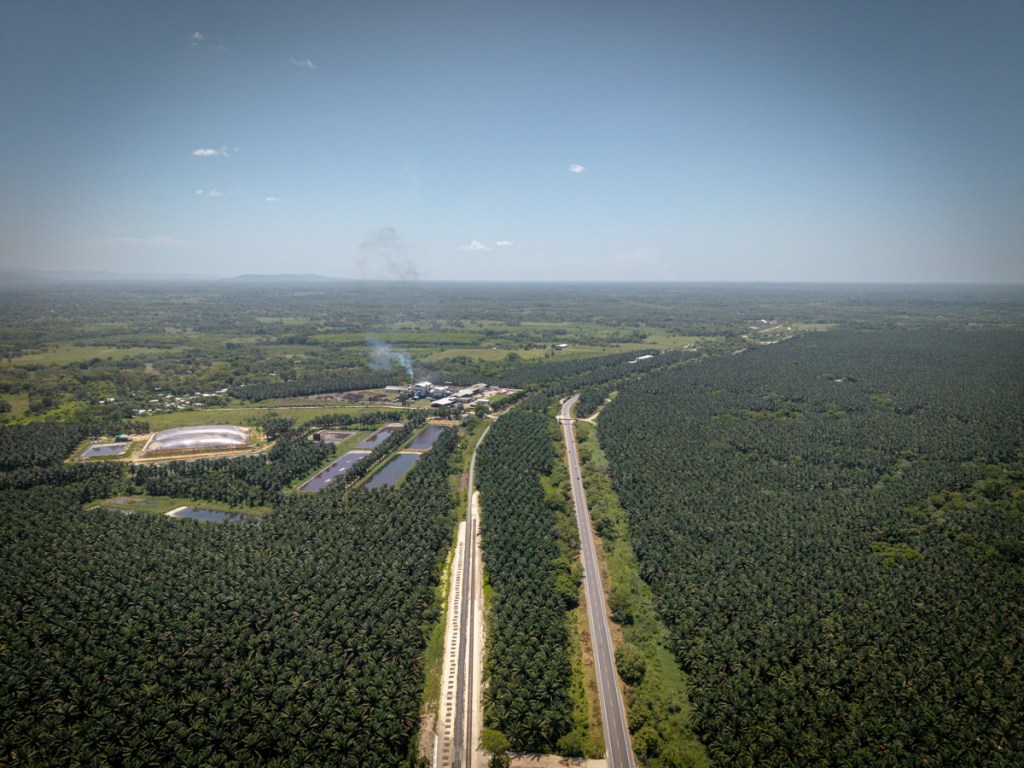
Photo Robin Canul.
After these penalties, the company changed its fiscal registry. Now, under the name of Palmosur, it operates a processing plant in the Palenque area of Chiapas. According to the Public Business Registry, the company’s legal representatives are the Mexican firm Mijares, Angoitia, Cortés and Fuentes. The firm’s director, Horacio María De Uriarte Flores, has also invested in Palma Tica.
One of the firm’s associates, Patricio Danel González, founded the company Quiet Water MX LTD in the United Kingdom when he was 23. He kept it as a “dormant account,” without operations, until selling it in 2024. The buyer was Jorge Esteve Recolons, owner of Agroforestal Uumbal, which owns one of the three processing plants for palm oil in Palenque, and leader of Ecom International, a large coffee, sugar and cacao marketer.
The Guatemalan Families
While Mexico produces 240,000 tonnes of palm oil annually, Guatemala surpassed one million tonnes in 2022. Investors from the Central American country have turned to Mexico. Among them are the Arriola Torrebiarte group, which has invested in African palm in the south of Chiapas since in the 1990s. They have invested in the Soconusco region, part of a rainforest rich in biodiversity. They partner with the Mexican company Propalma, also known as Oleosur, and owner of the Acapetahua processing plant.
Among the Mexican associates of the palm conglomerates linked to Oleosur — including Plantaciones del Soconusco, Grupo Apol and Promoción e Industrialización y Promoción de Palma — appears the Terrones López family, which runs the port of Altamira. Víctor Manuel Terrones, ex-president of the National Chamber of Industrial Transformation, stands out. The Chamber brings together the biggest families and groups in Mexican industry.
The families of the economic elite tend to invest with others who have the same class status or inter-marry to maintain their position within the oligarchy, a common phenomenon around the world. Thanks to authors including Marta Elena Casaús, Paul Dosal and Alejandra Colom, Guatemala is a pioneer in Latin America for the in-depth studies on the 22 families that make up the nation’s elite and main investors.

Their work has traced the family and business connections between the Guatemalan investors in Oleosur, José María Köng Serra, with Juan Miguel Torrebiarte L. and José Miguel Enrique Arriola Fuxet. The latter is also an investor in Aceites Sustentables de Palma and Palmas de Comillas, subsidiaries of the Chiapas Fund.
The Guatemalan contingent of this conglomerate includes Juan Estuardo Maegli Novella and Carmen María Torrebiarte Benefort. They are related through the Novella Torrebiarte family, which owns the country’s cement monopoly. They are also related to the family of former president Óscar Berger, who in 2006 announced a “Marshall Plan” for “the stimulus of African palm cultivation and building a highway through the Franja Transversal del Norte.” This crossed the palm zone of the country and ended in the municipality of Gracias a Dios, on the border with Chiapas.
In April 2024 Carmen María Torrebiarte became the first women president of the Coordinating Committee of Agricultural, Commercial, Industrial and Financial Associations, known as Cacif, where the most powerful families of the country rub elbows. They are responsible for picking and disposing of presidents, specifically, through coups d’etat.
An investigation by the news outlet El Faro, published in 2013, had already revealed the participation of the Cacif owners in the genocide against the Ixil people. In recent years they have also been implicated in the political persecution of journalists, human rights defenders and anti-corruption prosecutors, who have come to be known as the “new Guatemalan exiles.”
The other Guatemalan company linked to oil palm in Mexico is the Hame Group, owned by Hugo Alberto Molina Botrán. He has woven a network of businesspeople and investors including Ernesto Godoy Chuy, the director of its Peruvian affiliate Agrokasa Holdings. Another associate is Manuel de Jesús Elías Higueros, who was fined in 2016 for fiscal fraud in Guatemala. Both individuals are listed as owners of the palm processing plant Palmas de Candelaria in the state of Campeche.
A recounting of the business history of Hame Group in Guatemala cannot leave out the ecocide in the La Pasión river in Sayaxché, Petén. The massive die off of fish occurred in 2015. The responsible party was one of the companies in the group, which from its very name inspires confusion: Palm Reforestation of Petén, S.A. (REPSA).
This is one of the most common manipulations of palm companies globally to increase public acceptance of the devastating industry. But it must be made clear: planting a monocrop is not the same as reforesting.
According to a 2021 investigation by Mongabay, up until that year in Guatemala there were 48 open cases and complaints related to palm companies. Thirteen of them were linked to the Hame Group or its affiliates. Of all the cases, only two resulted in financial penalties.
The Friend of Power
Mohammad Yusuf Amdani Bai, owner of the Karims Group, is clear: “Nearshoring begins and ends in Mexico.” That’s why this businessman, born in Pakistan and a naturalized Honduran citizen, has kept one foot in Mexico since 1999. His investments in palm oil, which along with textiles, have made him one of the richest men in Honduras and Central America.
In Honduras Yusuf is known for being attentive to the powerful, including being thought to have financed the electoral campaigns of expresident Juan Orlando Hernández, imprisoned in the United States since 2022 for drug trafficking, and released by presidential pardon December 2, 2025. In Mexico his connections have allowed him to start businesses with people very close to politics through a complicated network of firms operated by his confidantes.
According to Mexico’s commercial registry, Amdani Bai owns the companies Campeche Holdings SA de CV and Desarrollo Agroindustrial de Campeche. Much like the previous cases, there are close ties between businessmen and local and regional politicians. Alfredo Flores Ríos has been the administrator of Amdani Bai’s Mexican companies Campeche Oil Mill, Palma Real del Sureste and Gez Grupo de Negocios Empresariales del Sureste. The latter is the property of Luis Antonio Espinosa Cárdenas, brother of the ex-governor of Campeche and palm promoter Alejandro Moreno Cárdenas, whose secretary of agriculture is also a prominent palm entrepreneur.
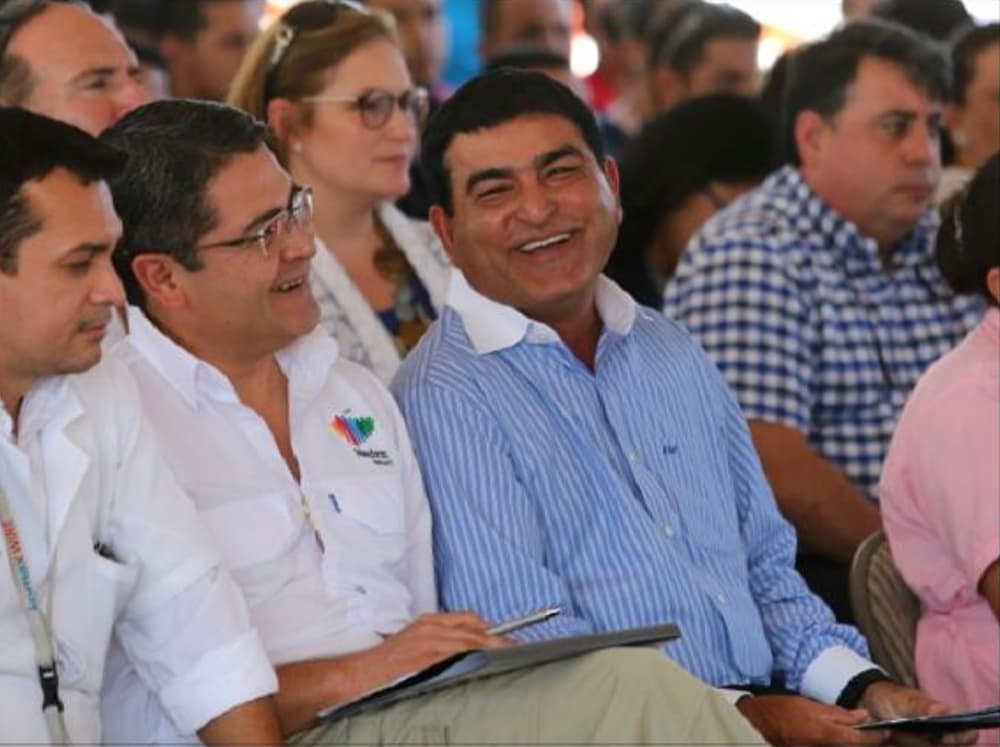
The relationship with the ex-governor has been more than friendly. Using flight logs, journalist Daniel Sánchez reported that a private jet owned by the state of Campeche has made several trips to Honduras, primarily to San Pedro Sula, where Yusuf Amdani lives.
In 2018, journalists revealed that the company Palma Real, lead by Carlos Enrique Soberais the CEO of the Karims group, “destroyed hundreds of hectares of rainforest and built an irrigation system to plant palms in the influence zone of the Laguna de Términos Wildlife and Flora Protection Zone.” The Profepa delegate, Luis Enrique Mena Calderón, who allowed the irregular activity to continue, suspiciously is the cousin of Alejandro Moreno.
In 2023, the U.S. State Department included Mohammad Yusuf Amdani Bai on the “Engel List” of “corrupt actors,” accusing him of bribing Honduran officials for business deals. This could be a constant in his way of doing business, which appears to depend not just on profits but also his networks and capacity to influence the political class.
They Never Lose
Thirty years ago, the efforts of people like McNamara to impose a model of neoliberal capitalism, with the United States as the hegemonic power, appeared to be solidifying with the advent of NAFTA. But thirty years ago, the Indigenous people of the EZLN ruined the party with their calls of “Enough!” and their armed uprising. They revolted because of the cycle of “exploitation, displacement, disregard and repression” that the new political order imposed. Because for them, the new order was just like the old one, and the one before that.
Because for them, the new order was just like the old one, and the one before that.
Years have gone by since the government, businesspeople and international development organizations sold lands where everything rots from the excess water and gave away African palms with the promise of prosperity. After traveling through three palm-producing states we saw that the land, the palms and the promises are all withering away.

The cycle that the EZLN spoke out against remains. Rural communities fell into a new trap of exploitation in the palm industry. The industry grabs land and displaces people from their territory. The less productive farmers have their harvest discounted, leaving them in economic vulnerability. If they complain, repression follows.
The cycle of displacement continues. While investigations into the agroindustrial conglomerates languish in national and international courts, with the exception of the case against Chiquita Brands in Colombia, the majority of rural farming communities remain impoverished and servile to states, politicians and a business class that considers them cheap and disposable labor.
“I don’t know why but the palm plant is like an enemy to animals. They don’t eat the fruit. Just the chombo. Do you know the chombo? Yes, what they call the zopilote.” Jerónimo explains while he breaks open a soursop that a parrot has dropped. “At our little place, fortunately there are still animals, thank God that they are still living here. Because there are other communities that practically don’t have any animals left. There’s nothing. That’s why our fight, along with all the living things, for nature.”
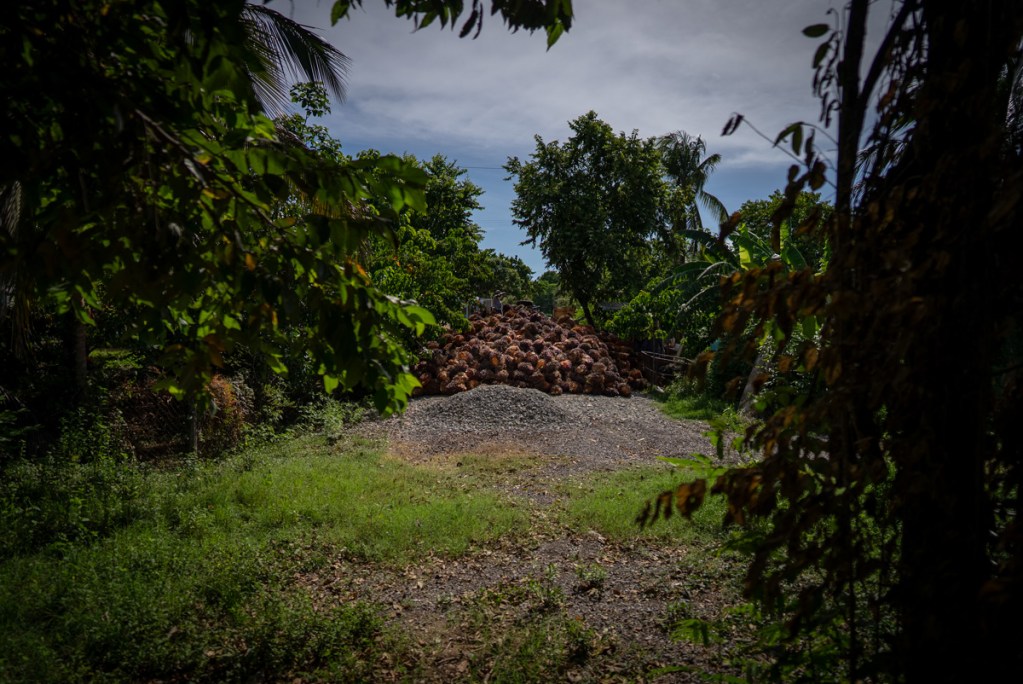
In early November 2025, we asked Profepa for the status of the closed plants. In an email, they answered, “The National Environment Prosecutor’s Office (Profepa) lifted the closure orders for the palm oil processing plants once they proved they had complied with the corrective measures imposed, among them the construction of confinement cells, cleaning muds and the installation of meters. Two of the plants are in ongoing administrative processes because they have not presented the proof of their water rights.”
There are only two types of monoculture agriculture in the world: that which has already impacted the environment and that which will impact the environment. This is because it requires large amounts of agrochemicals and eliminates any other form of vegetation.
Because it has happened before doesn’t stop it from happening again. That’s why fines and penalties will not be enough if they are surpassed by the economic profits and competitive advantages that allow these companies to evade the rules.
According to the journal The Lancet, in 2023 the ultraprocessed food industry had annual sales of $1.9 trillion. For comparison, the Gross Domestic Product of Mexico, the second biggest economy in Latin America, during this same period was $1.7 trillion and Colombia, the principal palm oil producer in the region, was $336 billion.
With these resources, the global ultraprocessed food corporations and their supply chains have amassed political power that allows them to influence government decisions, shape public debate and block regulations through lobbying, lawsuits, media campaigns and even sowing scientific doubt.
In 1961, U.S. president Dwight D. Eisenhower warned during his famous farewell address of the danger he called the “military industrial complex.” At the same time an agro-industrial complex was developing which turned out to be much more dangerous and with just as much power as the other. But its rise passed unnoticed, because if anyone will obviously be afraid if they have a gun in their face, who will suspect a cookie?
This report was funded as part of the Bertha Challenge 2025. To learn more about this project, click here.

- de la Vega-Leinert AC, Sandoval Vázquez SD, Vega del Valle ID. 2023. Mapping of the expansion of oil palm (Elais guineensis Jacq.) in Mexico — Methodology and developments. https://epub.ub.uni-greifswald.de/frontdoor/deliver/index/docId/11384/file/2998.pdf ↩︎
- Request from Norway for IBRD Views on the Integrated Program for Commodities. Development Policy – Commodities – Palm Oil – June 1976 – November 1976, Folder ID 30124838. World Bank Group Archives, Washington, D.C., United States. ↩︎
- Bobrow-Strain, Aaron. 2015. Enemigos íntimos. Terratenientes, poder y violencia en Chiapas. Unam. San Cristóbal de Las Casas. cimsur/conaculta: coneculta/ unach/ unicach/unich/cocytech/, 2015. ↩︎
- Castellanos Navarrete, Antonio. 2024. Fronteras de aceite: Hegemonía de la palma africana en Chiapas. UNAM. ↩︎
- https://www.hrw.org/report/2014/02/12/there-are-no-investigations-here/impunity-killings-and-other-abuses-bajo-aguan ↩︎
Bertha Fellow 2025. Periodista, corresponsal y editor especializado en América Latina. Ha colaborado con más de 40 medios en 25 países. Tiene un master en Estudios Internacionales. Se ha desempeñado como consultor de comunicación política para ONGs y organismos internacionales. Premio de periodismo Rostros de la Discriminación, 2022. Becario Balboa 2007. Director fundador de Comestible.info